Enabling a Safer Learning Community – Education Solution
Updated on October 21, 2022, by Xcitium
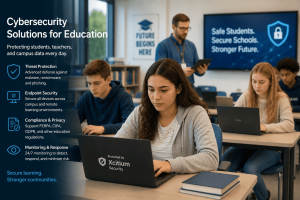
Top Cybersecurity Challenges in Education
Educational institutions have become prime targets for cybercriminals due to the large volumes of sensitive student, faculty, and research data they manage. Schools, colleges, and universities often operate complex networks with limited IT resources, making them vulnerable to cyberattacks.
Common challenges include:
- Ransomware attacks
- Phishing campaigns targeting students and staff
- Unmanaged student devices
- Data breaches involving student records
- Legacy systems and outdated software
- Limited cybersecurity staffing
- Remote learning security risks
- Third-party application vulnerabilities
Efficiently managing server and PC security can reduce costs and maximize the Internet’s benefit as a teaching and learning tool.
Local school districts through major universities are facing similar Internet security challenges as students and faculty become increasingly dependent on PC’s and the Internet.
With a protection landscape that features centralized management of digital certificates as well as PC endpoints, Xcitium understands the challenges of the educational community at all levels, and strives to make the Internet a safe and effective teaching and learning resource
Why Is Cybersecurity Important in Education?
Educational institutions store valuable personal, financial, academic, and research data that cybercriminals actively target. Effective cybersecurity protects students, faculty, staff, and institutional resources while ensuring uninterrupted learning experiences and regulatory compliance.
Benefits of Strong Education Cybersecurity
- Protects student records
- Prevents ransomware disruptions
- Secures hybrid learning environments
- Reduces data breach risks
- Supports regulatory compliance
- Protects research and intellectual property
- Enhances operational continuity
Protecting Schools and Universities from Ransomware
Ransomware remains one of the most significant threats facing educational institutions. Attackers frequently target schools because downtime can disrupt classes, examinations, and administrative operations.
An effective ransomware defense strategy includes:
- Endpoint protection
- Zero Trust security controls
- Continuous monitoring
- Vulnerability management
- Automated threat containment
- Secure backups
- Security awareness training
Education Compliance and Data Protection Requirements
Educational institutions must protect sensitive student and institutional data while meeting regulatory requirements.
Common Education Compliance Frameworks
| Framework | Purpose |
|---|---|
| FERPA | Protects student education records |
| CIPA | Internet safety requirements for schools |
| COPPA | Protects children’s online privacy |
| GDPR | Protects personal data for EU residents |
| State Education Privacy Laws | Student data security requirements |
How Xcitium Supports Compliance
Xcitium helps educational institutions maintain visibility, enforce security controls, and protect sensitive information while supporting compliance initiatives.
Why Choose Xcitium?
Xcitium serves hundreds of educational institutions from local school districts to some of the world’s largest and best known universities. In all cases, we offer the ability to efficiently manage the deployment and management of security infrastructure. Regardless of size, educational institutions benefit from Xcitium’s:
- Industry leadership as one of the two largest providers of high-assurance digital certificates
- Easy to deploy and use centralized management tools for both digital certificate and PC endpoints
- Low-cost, highly effective PC Endpoint Security Solutions
- Competitive pricing, streamlined administration, and fewer security breaches
- Ongoing stream of innovation to meet the challenges of the evolving threat landscape
Educational Industry Solutions
Digital Certificates/SSL and Certificate Management
Data encryption and site authentication for virtually any educational environment or application. Includes advanced certificate management tools to bring efficiency and cost saving to securing decentralized environments, as well as a full range of digital certificate types.
Endpoint Security
Schools, Colleges and Universities can slash licensing fee expenditure, raise overall security and reduce desk-side support visits by deploying Xcitium Endpoint Security Manager to protect network workstations.
Mobile Device Management
Xcitium’s unconventional approach to licensing users instead of devices allows Schools, Colleges, and Universities to simplify overall management and slash lifetime deployment costs while securing their mobile devices.
Next Steps
Speak with a Xcitium expert to share your security challenges and benefit from our experience.
Securing Remote and Hybrid Learning Environments
The growth of remote and hybrid learning has expanded the attack surface for educational institutions. Students, faculty, and administrators now access school resources from various locations and devices.
Key security requirements include:
- Endpoint security for remote devices
- Secure access controls
- Multi-factor authentication
- Continuous threat monitoring
- Application security
- Cloud workload protection
Why Educational Institutions Need Zero Trust Security
Traditional perimeter-based security is no longer sufficient for modern educational environments. Zero Trust assumes that no user or device should be trusted automatically, regardless of location.
Zero Trust principles help schools:
- Verify every user and device
- Limit lateral movement
- Reduce insider threats
- Secure remote learning environments
- Protect sensitive academic data
Supporting Lean IT Teams in Education
Many educational institutions operate with limited cybersecurity budgets and small IT teams. Automated security solutions help reduce operational complexity by streamlining:
- Threat detection
- Vulnerability management
- Compliance reporting
- Endpoint protection
- Incident response
- Asset visibility
Frequently Asked Questions
Why are schools and universities targeted by cybercriminals?
Educational institutions store valuable student, financial, and research data while often operating with limited cybersecurity resources, making them attractive targets for attackers.
What are the biggest cybersecurity threats facing schools?
The most common threats include ransomware, phishing attacks, credential theft, malware infections, data breaches, and vulnerabilities introduced through remote learning environments.
What compliance requirements apply to educational institutions?
Many schools must comply with FERPA, CIPA, COPPA, GDPR, and various state-level education privacy regulations.
How can educational institutions improve cybersecurity?
Organizations can improve security through endpoint protection, Zero Trust strategies, continuous monitoring, vulnerability management, employee training, and automated threat response.
How does cybersecurity support remote learning?
Cybersecurity solutions protect student devices, secure cloud applications, prevent unauthorized access, and ensure the integrity of online learning environments.
Speak With a Xcitium Solutions Expert

