Digital Certificates for Financial Solutions institutions
Updated on October 21, 2022, by Xcitium
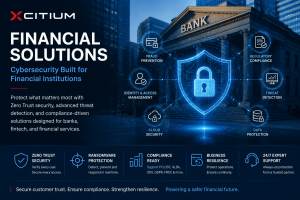
Cybersecurity Challenges Facing Financial Institutions
Financial institutions are among the most targeted industries for cyberattacks because they manage highly sensitive customer data, payment systems, and financial transactions.
Modern financial organizations face growing risks from:
- Ransomware attacks
- Banking Trojans and malware
- Phishing and business email compromise (BEC)
- Insider threats
- API attacks targeting digital banking platforms
- Supply chain compromises
- Credential theft
- Distributed denial-of-service (DDoS) attacks
As digital banking services expand, financial institutions require advanced cybersecurity strategies that protect customer data, maintain regulatory compliance, and ensure operational resilience.
Solutions Industry Making Financial Solutions Transactions More Secure.
Financial institutions need a responsive and innovative partner to deliver an effective protection landscape.
With threats to financial institutions and their customers escalating at an unprecedented rate, Xcitiumis continually innovating to counter them with an effective protection landscape.
Xcitium protects financial institutions of all sizes with leading-edge security and authentication solutions for Internet banking applications, websites, enterprise applications, messaging, and more.
Financial Compliance and Regulatory Security Requirements
Financial institutions must comply with strict cybersecurity and data protection regulations designed to protect customer information and maintain operational integrity.
Key regulatory frameworks include:
- PCI DSS
- GLBA (Gramm-Leach-Bliley Act)
- SOX (Sarbanes-Oxley Act)
- FFIEC cybersecurity guidelines
- GDPR
- DORA (Digital Operational Resilience Act)
Cybersecurity solutions for financial services should support:
- Continuous monitoring
- Threat detection
- Access control
- Audit logging
- Vulnerability management
- Incident response
- Compliance reporting
A proactive cybersecurity strategy helps financial organizations reduce risk while meeting evolving regulatory requirements.
Zero Trust Security for Financial Institutions
Traditional perimeter-based security is no longer sufficient for modern banking environments.
Zero Trust security follows the principle of:
“Never trust, always verify.”
Financial institutions should implement:
- Multi-factor authentication (MFA)
- Least-privilege access controls
- Identity verification
- Continuous user monitoring
- Device trust validation
- Micro-segmentation
Zero Trust architectures help prevent unauthorized access, reduce insider risk, and limit the spread of cyberattacks across financial networks.
Financial Institutions Industry Solutions Points Below
Digital Certificates/SSL and Certificate Management
Data encryption and site authentication for virtually any educational environment or application. Includes advanced certificate management tools to bring efficiency and cost saving to securing decentralized environments, as well as a full range of digital certificate types.
Endpoint Security
Schools, Colleges, and Universities can slash licensing fee expenditures, raise overall security, and reduce desk-side support visits by deploying Xcitium Endpoint Security Manager to protect network workstations.
Compliance and Monitoring
Compliance frequently involves taking proactive steps to counter security threats. Monitoring Internet-connected resources for vulnerabilities is a widely recognized best practice as well as a growing compliance requirement. Additionally, Xcitium is a PCI Approved Scanning Vendor (ASV) that financial institutions use to help their customers achieve PCI compliance.
Mobile Device Management
Xcitium’s unconventional approach to licensing users instead of devices allows Schools, Colleges, and Universities to simplify overall management and slash lifetime deployment costs while securing their mobile devices.
Next Steps
Speak with a Xcitium expert to share your security challenges and benefit from our experience.
Fraud Prevention Solutions for Financial Services
Financial organizations must protect customers and payment systems from increasingly sophisticated fraud attacks.
Modern financial cybersecurity solutions help detect and prevent:
- Account takeover attacks
- Credential theft
- Payment fraud
- Identity fraud
- Unauthorized transactions
- Social engineering attacks
Advanced fraud prevention technologies use:
- Behavioral analytics
- AI-driven anomaly detection
- Real-time monitoring
- Threat intelligence
- Secure authentication
These capabilities help reduce financial losses while protecting customer trust.
This is a major competitor advantage.
Ransomware Protection for Financial Institutions
Ransomware attacks can disrupt banking operations, compromise sensitive customer data, and create significant financial and reputational damage.
Financial organizations require layered ransomware protection that includes:
- Endpoint detection and response (EDR)
- Backup protection
- Threat containment
- Network segmentation
- Email security
- Security awareness training
- Incident response capabilities
Cyber resilience strategies help financial institutions maintain operational continuity even during active cyber incidents.
Cloud and API Security for Digital Banking
Financial services organizations increasingly rely on:
- cloud platforms,
- mobile banking applications,
- fintech integrations,
- and APIs.
These technologies expand the attack surface and require specialized security controls.
Cloud and API security solutions help:
- Protect sensitive financial data
- Prevent API abuse
- Detect unauthorized access
- Secure mobile banking traffic
- Monitor cloud workloads
- Encrypt sensitive communications
Comprehensive visibility across hybrid and multi-cloud environments is critical for modern financial cybersecurity.
Why Cybersecurity Is Critical for Financial Services
Financial institutions process enormous volumes of sensitive financial and personal information every day.
A successful cyberattack can lead to:
- Financial losses
- Regulatory penalties
- Service disruptions
- Reputational damage
- Customer attrition
Strong cybersecurity solutions help financial organizations:
- Protect customer trust
- Maintain compliance
- Secure digital banking systems
- Prevent fraud
- Improve operational resilience
- Detect threats in real time
Financial Cybersecurity Solutions Comparison
| Security Capability | Purpose | Benefit for Financial Institutions |
|---|---|---|
| Endpoint Detection & Response (EDR) | Detects advanced threats | Faster ransomware containment |
| Zero Trust Security | Verifies every access request | Reduces unauthorized access |
| SIEM & Threat Monitoring | Centralized visibility | Faster incident response |
| MFA & Identity Protection | Secures user accounts | Prevents credential theft |
| Cloud Security | Protects cloud workloads | Secures digital banking systems |
| API Security | Monitors API traffic | Prevents API abuse and data theft |
| Backup & Recovery | Restores operations | Improves cyber resilience |
Related Sources:

 Loading...